
Introduction
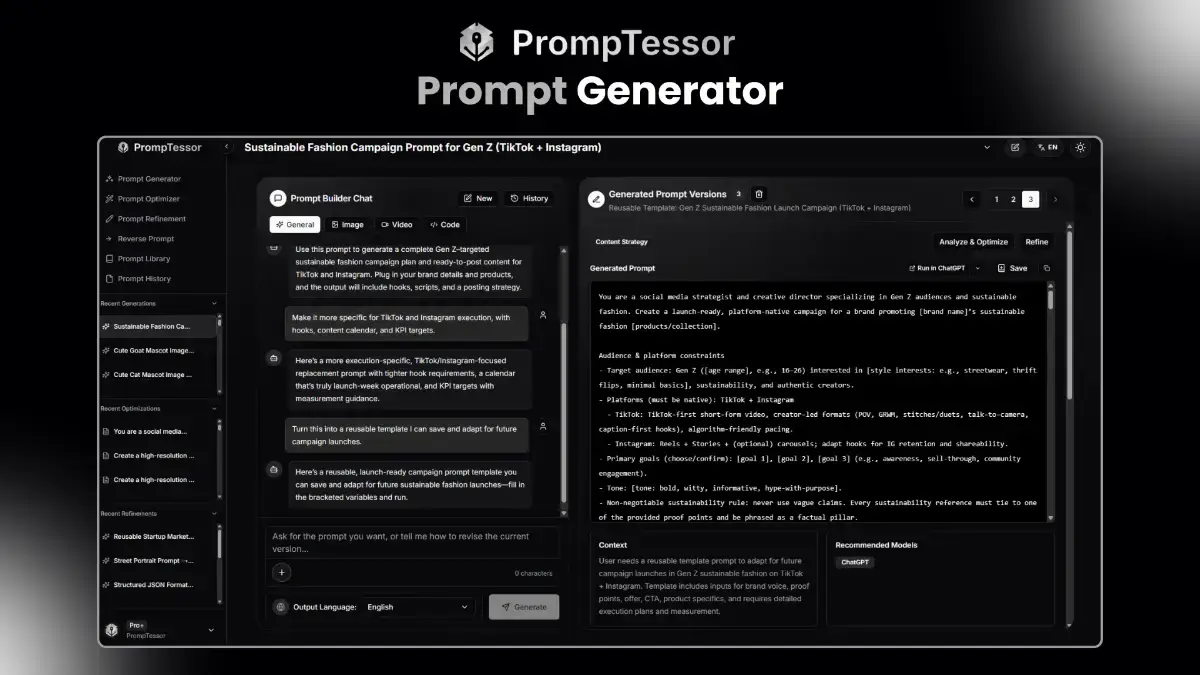
PrompTessor is an AI prompt workspace for generating, analyzing, optimizing, refining, reverse-engineering, saving, and reusing prompts across different AI tools and workflows.
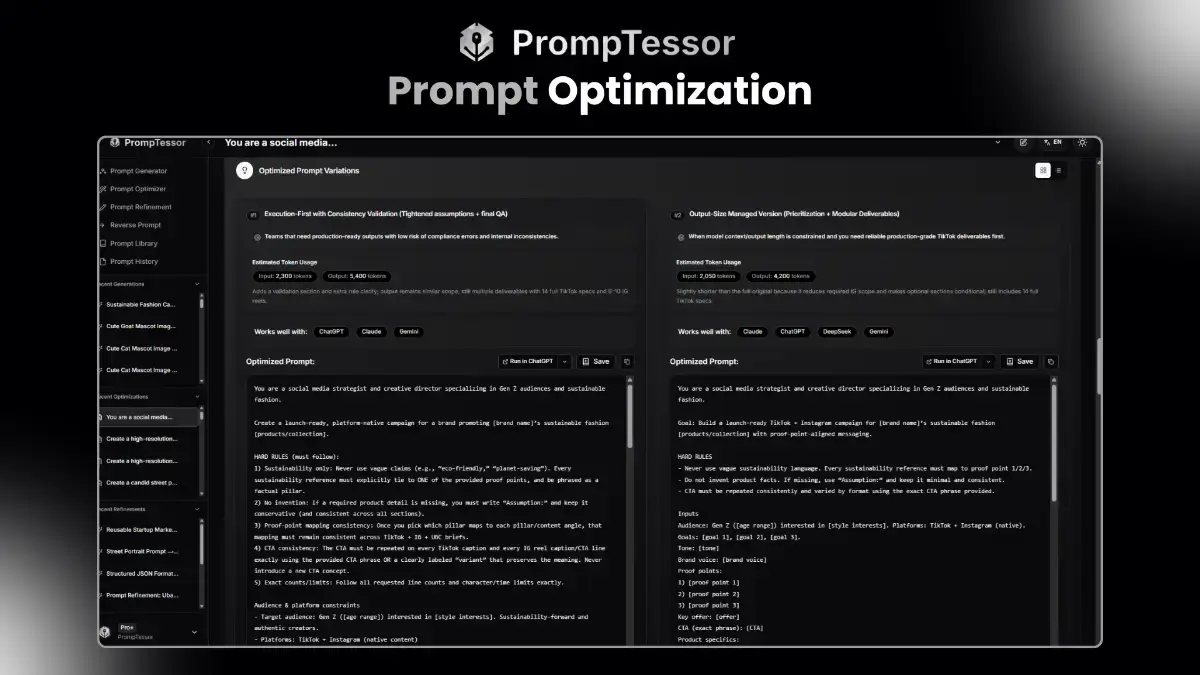
Turn ideas, goals, tasks, and briefs into structured prompts with Prompt Generator. Evaluate existing prompts using clear scoring, detailed quality metrics, strengths, weaknesses, estimated input and output token usage, model recommendations, and actionable improvement guidance. Prompt Optimizer then transforms existing prompts into clearer, more specific, structured, and reusable versions.
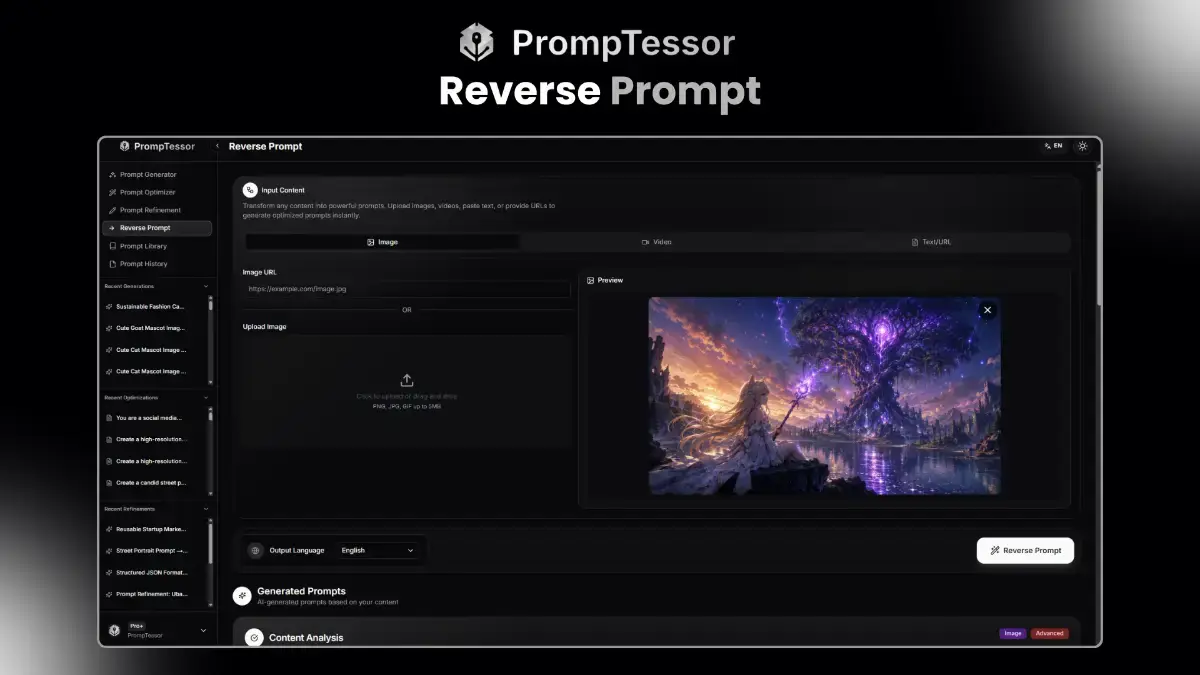
PrompTessor also includes Reverse Prompt, which converts images, videos, text, and accessible URLs into reusable prompt structures. It extracts useful attributes such as composition, style, intent, format, movement, pacing, and content patterns without claiming to recover the exact original prompt.
Generated, optimized, or reverse-engineered prompts can be revised through Prompt Refinement using specific feedback, then tested, compared, and saved to Prompt Library for private use, community sharing, or future workflows.
Key Features
Prompt Generator
Turn ideas, goals, tasks, briefs, visual references, and output requirements into structured, ready-to-use prompts.Prompt Analysis
Evaluate prompts using an overall score, strengths, weaknesses, difficulty, suggested use cases, compatible AI models, estimated input and output token usage, and six quality metrics: clarity, specificity, context, goal orientation, structure, and constraints.Prompt Optimizer
Improve existing prompts with clearer instructions, stronger context, better structure, useful constraints, and more reliable output requirements.Reverse Prompt
Convert images, videos, text, and accessible URLs into reusable prompts by extracting their structure, style, intent, format, composition, movement, and other repeatable attributes.Prompt Refinement
Revise existing prompts using specific feedback, such as changing the tone, format, length, detail level, audience, target model, or output direction.Prompt Library
Save, organize, discover, share, and reuse prompts through private, community, and official collections with categories, model guidance, usage notes, examples, and visibility controls.Prompt History and Versions
Review and manage generated, analyzed, optimized, and refined prompt versions without losing earlier iterations.Model-Agnostic Workflows
Create prompts for ChatGPT, Claude, Gemini, image and video generators, coding assistants, writing tools, and other AI systems.
Benefits
Create better prompts faster: Transform rough ideas or existing prompts into structured instructions with less trial and error.
Improve AI output quality: Produce clearer, more relevant, consistent, and controllable results.
Understand prompt quality: Learn what works through scores, metrics, strengths, weaknesses, token estimates, and practical recommendations.
Reuse successful patterns: Convert useful content and proven prompt structures into repeatable workflows.
Iterate efficiently: Analyze, optimize, refine, test, and compare prompt versions in one workspace.
Keep prompts organized: Store valuable prompts in Prompt Library instead of losing them in chat history.
Support team workflows: Maintain reusable prompts for marketing, product, development, research, content, and operations.
Use Cases
Creators and Designers
Generate visual prompts or reverse-engineer image and video references into reusable creative directions covering composition, lighting, camera behavior, movement, pacing, and style.
Marketers and Copywriters
Create and improve prompts for campaigns, advertisements, landing pages, calls to action, content calendars, social media, and audience research.
Product and Business Teams
Build reusable prompts for product briefs, customer research, documentation, reports, meeting summaries, internal workflows, and AI assistants.
Developers and Technical Teams
Improve prompts for coding assistants, debugging, architecture reviews, documentation, testing strategies, and implementation planning.
AI Researchers and Prompt Engineers
Evaluate prompt quality, compare versions, inspect metrics and estimated token usage, test constraints, and develop reusable prompt patterns across different models.
Educators and Students
Study prompt structure, analyze examples, understand effective prompting patterns, and create clearer instructions for learning and research.